The "Reverse Flip": Why 2026 is the Year Indian Startups are Coming Home
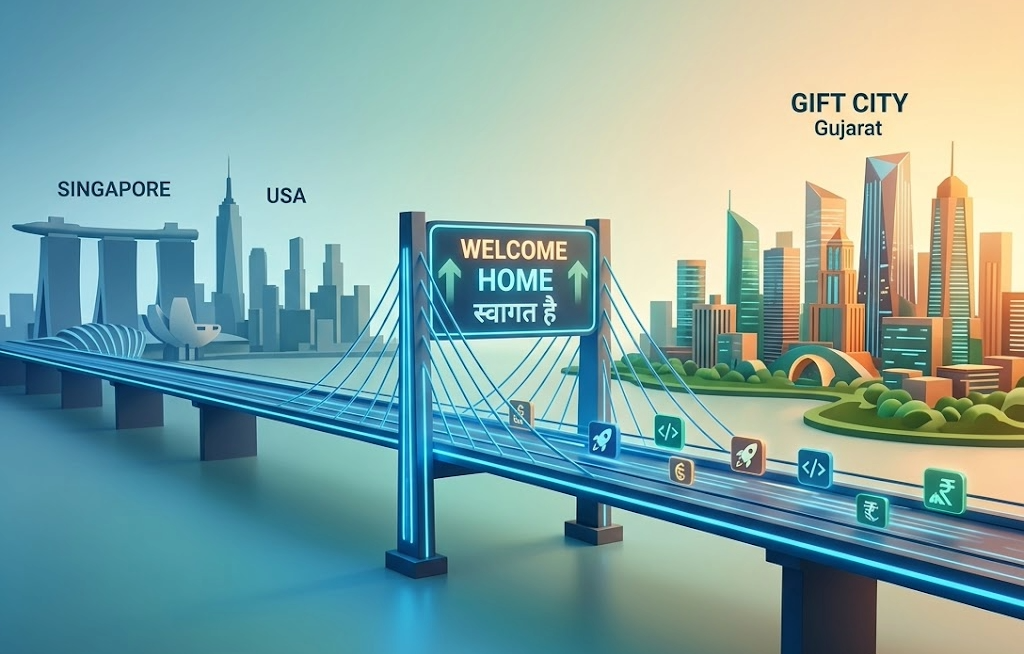
For the last decade, the "Flip" was the gold standard for Indian startups. Founders would incorporate in Delaware or Singapore, keeping the Indian entity as a mere subsidiary to attract foreign VC money. But as of April 2026, the tide has officially turned. We are witnessing the "Great Reverse Flip."
The Regulatory Magnet
The primary reason for this homecoming is the 2026 Direct Tax Code (DTC) amendment. The government has introduced a specific "tax-neutral" window for companies re-domiciling to India. In simple terms: if you bring your holding company back to India, the transition is no longer treated as a "capital gains event" for the founders.
This is a massive relief for companies that were previously terrified of the huge tax bill that would hit them the moment they tried to move their headquarters back to Gurugram or Bengaluru.
The GIFT City Advantage
Most of this "Reverse Flipping" is landing in GIFT City, Gujarat. It is acting as a "neutral zone" that feels like Singapore but operates under Indian law. By setting up a base here, startups are accessing:
-
Zero Tax on Capital Gains for 10 years.
-
Liberalized Foreign Exchange: It’s easier to pay global vendors in USD without the usual FEMA (Foreign Exchange Management Act) headaches.
-
Listing Readiness: SEBI has simplified the rules for GIFT City companies to list directly on the NSE/BSE, giving founders a much faster path to an IPO (Initial Public Offering).
Shift in Investor Sentiment
Foreign investors are no longer demanding Delaware structures. The Indian public market is now so "hot" that VCs want their portfolio companies to be Indian entities. They realize that an IPO in India often yields a higher valuation than a quiet exit in a crowded US market.
What this means for the "GrowMax" Scale Entrepreneur
Even if you aren't a unicorn, this shift affects you. The "Reverse Flip" is creating a surge in domestic M&A (Mergers and Acquisitions). Large startups coming back to India are looking to acquire smaller, profitable MSMEs to bolster their balance sheets before they go public.
If your MSME is tech-enabled and has clean compliance (GST, ITR, and Labor Codes), you are no longer just a "small business"—you are an acquisition target for the giants coming home. The key to being "acquisition-ready" in 2026 is having your digital records in such a perfect state that a "Big Four" auditor couldn't find a single flaw.