Is This the Right Time to Invest in Indian Stocks During the Iran–Israel War?
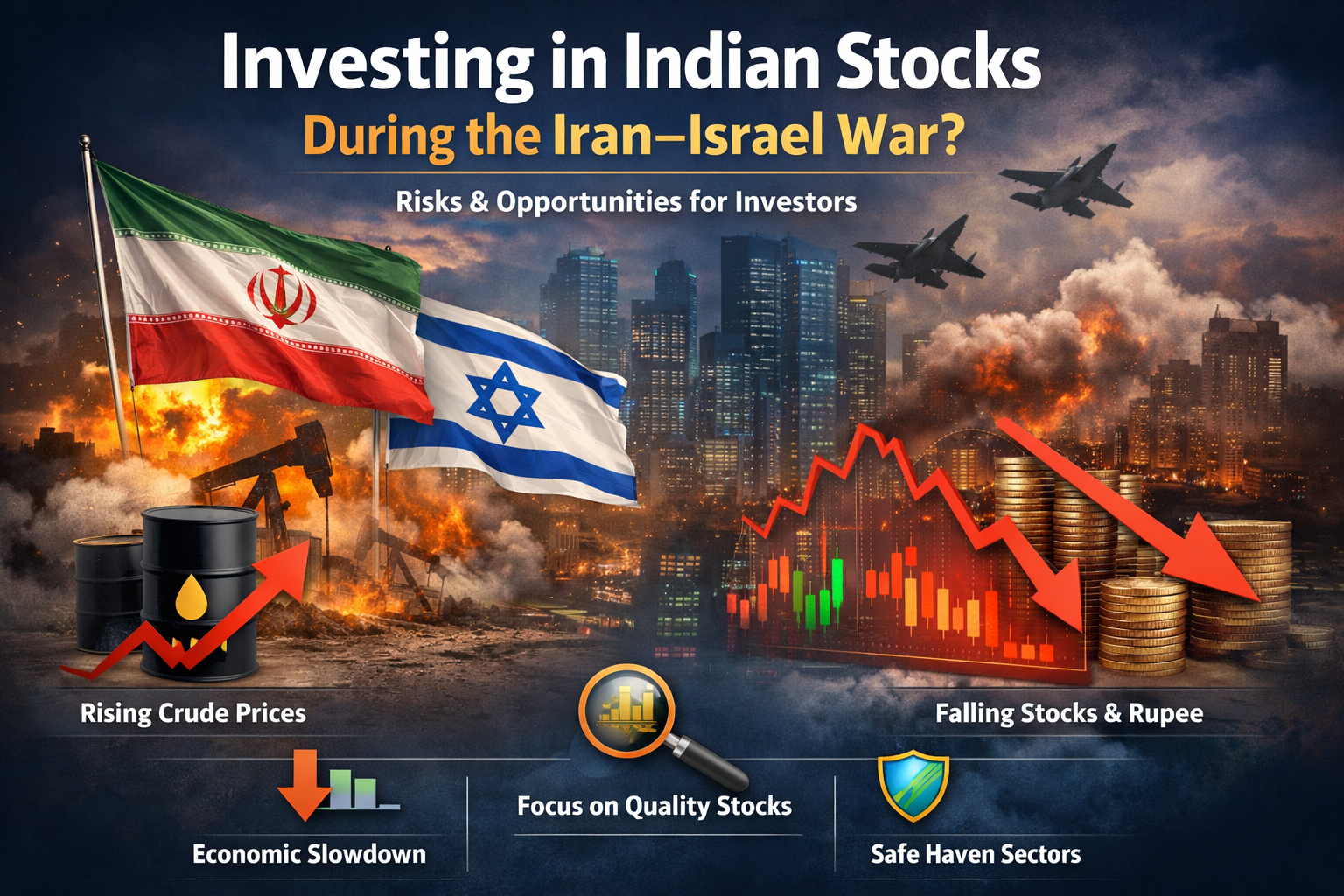
The Iran–Israel war is no longer just a distant news headline; it has started to shape the mood of Indian investors, the performance of the stock market, and the path of the country’s economy. As crude prices jump, headlines flash, and some big-name stocks plunge, many of you are asking: Is this the right time to invest?
In this blog, we will walk through the real impact of the war on India, showcase how specific listed shares have reacted, and then explore what might happen if the conflict ends or drags on. We’ll also bring in other key factors—like crude prices, interest rates, and investor behaviour—that should guide your decision, not fear.
How the Iran–Israel War is Shaping the Indian Economy
Wars don’t stay inside borders; they seep into the economy through trade, energy, and investor psychology. The current conflict is affecting India in three big ways:
· Oil, inflation, and growth
India imports a large share of its crude oil, and any spike or disruption in the Middle East raises the import bill. This feeds into higher fuel costs, transport costs, and eventually inflation. At the same time, the uncertainty weighs on business sentiment and investment, which can slow growth.
Market analysts have already revised India’s 2026 growth forecast downwards and warned that the comfortable mix of “strong growth plus controlled inflation” may weaken if the war continues.
· Rupee and external accounts
Higher oil imports mean more outflows, which can put pressure on the rupee. A weaker currency makes imports more expensive and adds to inflation, while also making foreign investors more cautious about India.
· Risk-off sentiment and stock markets
Global investors tend to move away from risky markets during such conflicts. This has led to FII selling and a sharp correction on Dalal Street, with the Nifty and broader indices shedding double?digit percentages in a short span.
Mid-cap and small-cap indices have corrected even more, wiping out a lot of wealth from recent IPOs and new-age listed companies.
How Listed Stocks Have Reacted: A Snapshot
To see whether this is a “good time” to invest, it helps to look at what stocks have actually fallen and how much. The table below gives a conceptual snapshot of major listed shares across sectors and the approximate percentage they have lost since the war escalated in early March 2026.
(Note: Percentage falls are indicative and based on post-war-escalation correction; exact numbers may vary by data source and date.)
Major Indian Stocks and Their Approximate Falls Due to the War
|
Sector |
Company Name |
Approx. % Fall (since war escalated) |
Why they were hit |
|
Automobiles |
Maruti Suzuki |
14–16% |
Higher fuel costs and weaker demand sentiment |
|
Eicher Motors |
14–16% |
Operating-cost pressure and macro worries |
|
|
Ashok Leyland |
19–22% |
Infrastructure and fleet-demand slowdown |
|
|
FMCG & Consumer |
Hindustan Unilever (HUL) |
14–16% |
Input-cost and logistics-cost pressure |
|
Godrej Consumer Products (GCPL) |
14–16% |
Commodity-linked input inflation |
|
|
Nestlé India |
13–15% |
Rising freight and packaging costs |
|
|
Infrastructure & Capital Markets |
Larsen & Toubro (L&T) |
19–22% |
Project-delay risks and Middle-East exposure |
|
UltraTech Cement |
~19% |
Construction-slowdown and cost-inflation fears |
|
|
SEPC Infrastructure |
23–40% |
Heavy project and order-book uncertainty |
|
|
Oil & Gas / Energy |
Indian Oil Corporation (IOC) |
13–17% |
Higher crude-cost pressure |
|
Bharat Petroleum (BPCL) |
13–17% |
Similar crude-cost and margin pressure |
|
|
Tata Steel |
13–17% |
Energy-intensive operations and global demand fear |
|
|
Rain Industries |
23–40% |
Export and raw-material disruption |
|
|
Financials / NBFCs |
Ugro Capital |
Double-digit fall |
Liquidity-sensitive and risk-off selling |
|
Fusion Finance / NBFCs |
Double-digit fall |
Higher risk-premium and FII-outflow effect |
|
|
Technology & Small-cap |
Infobeans Technologies |
23–30% |
Risk-off selling in small?caps |
|
Aqylon Nexus |
23–30% |
Sentiment-driven de-rating |
|
|
Rajesh Exports / Raju Exports |
23–30% |
Gulf-trade and jewellery-export worries |
This table shows that almost every sector has felt the heat, but the pain has been most visible in autos, FMCG, infrastructure, energy, and the risk-sensitive small-cap universe. The fall is not only about fundamentals; it is also about investor fear and higher discount rates.
If the War Ends: Will Stocks Boom?
Many investors assume that peace = instant boom for all war-hit stocks. That’s not how markets work. The recovery will be selective and quality-driven.
· What can improve
o If crude prices ease or stabilise, the pressure on OMCs, autos, paints, and FMCG will reduce, and margins can recover.
o Aviation, travel, and infrastructure companies may see better visibility and order flows once geopolitical uncertainty drops.
o Mid-cap and small-cap indices can bounce sharply if liquidity and risk-appetite return.
· What may still lag
o Companies with weak balance sheets, high debt, and poor profitability may not regain their old valuations quickly, even if the war ends.
o If crude stays high or global demand remains weak, export-oriented and capital-intensive sectors may continue to trade at lower multiples.
In simple terms: good-quality stocks can rebound sharply, but not every war-hit loser will automatically boom.
What If the War Continues or Escalates?
If the conflict drags on or worsens, the environment will stay tough:
· Crude prices may stay elevated, pushing inflation up and limiting the RBI’s room to cut rates.
· Growth forecasts could be revised further downward, and the “Goldilocks” story (strong growth plus low inflation) may fade.
· Stock markets could see more corrections in mid-cap and small-cap space, with investors rotating into more defensive sectors such as healthcare, utilities, and some consumer staples.
In that phase, the focus naturally shifts to capital preservation and quality over glamour.
Other Factors That Should Guide Your Investment Decision
Beyond the war headlines, a few key factors should shape your thinking:
· Time horizon
Long-term investors can use this volatility to average into quality businesses, while short-term traders need to respect the risk of sharp intraday swings.
· Quality and diversification
Focus on companies with strong cash flows, conservative debt, and sustainable business models. Spread your risk across sectors and market caps instead of hunting for a single “winner”.
· Systematic investing
SIPs or staggered buying help you avoid the trap of “timing the perfect bottom” and reduce the risk of putting all your money at a single risky point.
· Watch crude, yields, and RBI
Crude prices, government bond yields, and RBI’s stance on interest rates all influence equity valuations. If crude falls and rates stay benign, equities tend to look more attractive; if the reverse happens, valuations can get squeezed.
So, Is This the Right Time to Invest?
· If you are a long-term, quality-focused investor who can ignore short-term headlines, this might be a prudent window to build or add to positions in fundamentally strong businesses that have fallen with the crowd.
· If you are trading short-term, over-leveraged, or emotionally reacting to the news cycle, this may be a better time to wait, reassess, and protect capital rather than chase a “cheap” stock just because it has crashed.
The Iran–Israel war has created both fear and opportunity. The difference between losing money and making money will not depend on when the war ends, but on how disciplined, diversified, and quality-minded your investment approach is.